You’ve seen the photos. A giant golden frame standing in the desert, splitting Dubai in two-modern skyline on one side, historic Old Dubai on the other. It looks like something out of a sci-fi movie. But the Dubai Frame isn’t just a photo op. It’s a bold architectural statement, a cultural bridge, and one of the most thoughtful design experiments in modern urban history.
What Exactly Is the Dubai Frame?
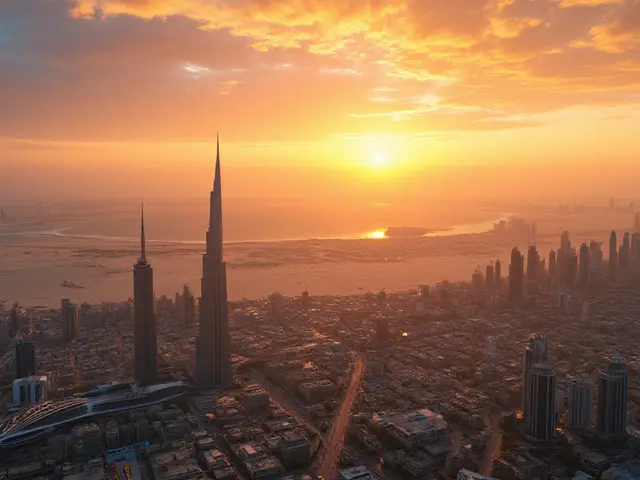
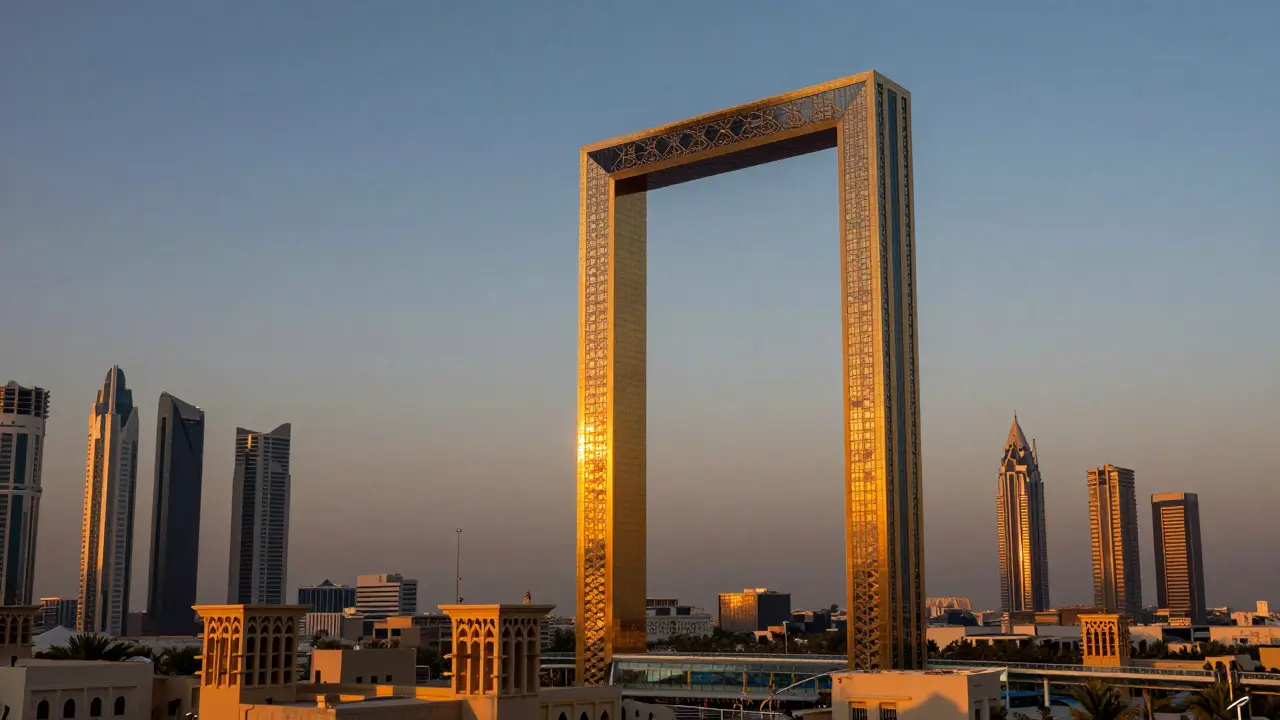
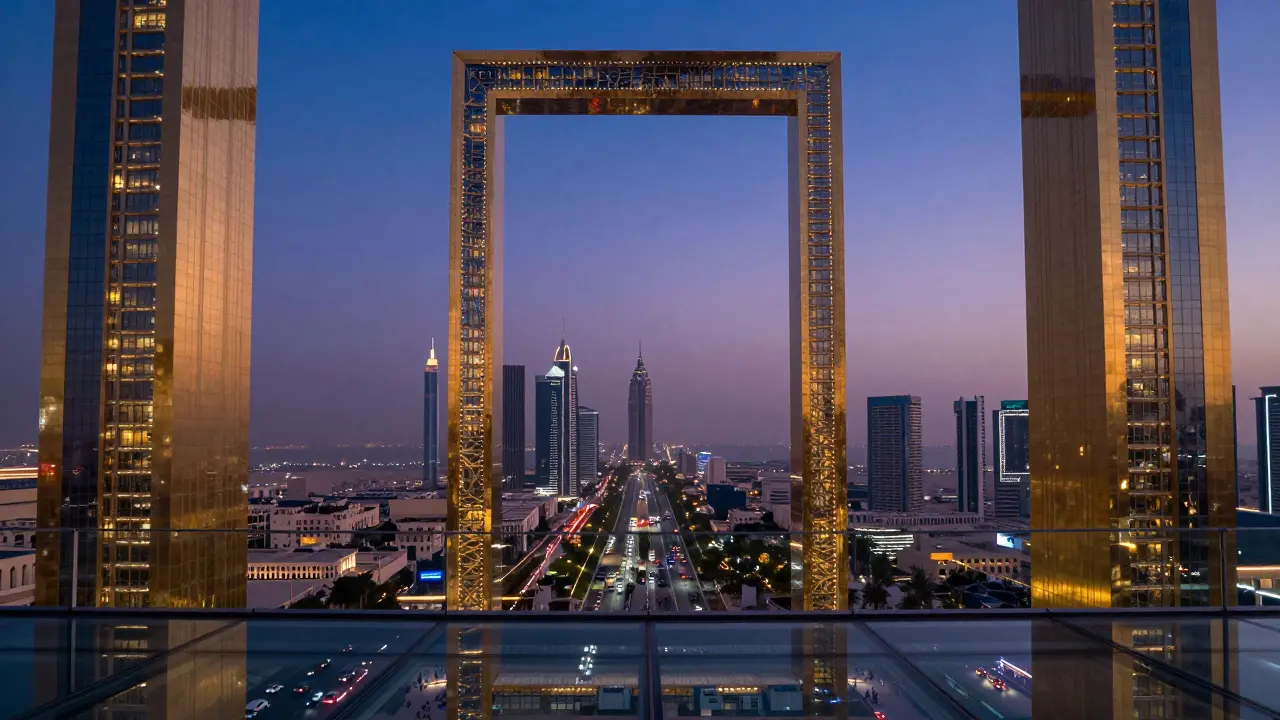
The Dubai Frame is a 150-meter-tall (492-foot) vertical structure shaped like a giant picture frame. It sits in Zabeel Park, connecting the old and new parts of the city. One side of the frame looks toward historic neighborhoods like Deira and Bur Dubai, where traditional wind-tower houses and narrow alleyways still stand. The other side faces the glittering towers of Downtown Dubai-Burj Khalifa, Dubai Mall, and the Dubai Fountain.
It was designed by Fernando Donis, a Mexican architect, and opened in 2018 after six years of planning. The structure isn’t just a monument-it’s a museum, an observation deck, and a symbolic gesture all in one. The frame’s golden cladding is made of 2,500 square meters of stainless steel and aluminum, polished to reflect sunlight like a mirror. At night, LED lighting turns it into a glowing beacon.
Think of it this way: if Dubai were a story, the Dubai Frame is the page turner. It doesn’t just show you the city-it forces you to compare its past and present, side by side.
Why Architecture Enthusiasts Should Care
If you love buildings that make you pause and think, the Dubai Frame delivers. It’s not just tall-it’s clever. Most skyscrapers aim to dominate the skyline. This one doesn’t compete. It frames. It isolates. It invites you to look differently.
The structure uses minimal materials to create maximum impact. No internal columns. No bulky support beams. The entire weight is carried by two vertical towers connected by a sky bridge. That bridge, suspended 93 meters above ground, is the only part you walk on. The rest is empty space-literally a hole in the middle. That’s rare in architecture. Most buildings fill space. This one defines it.
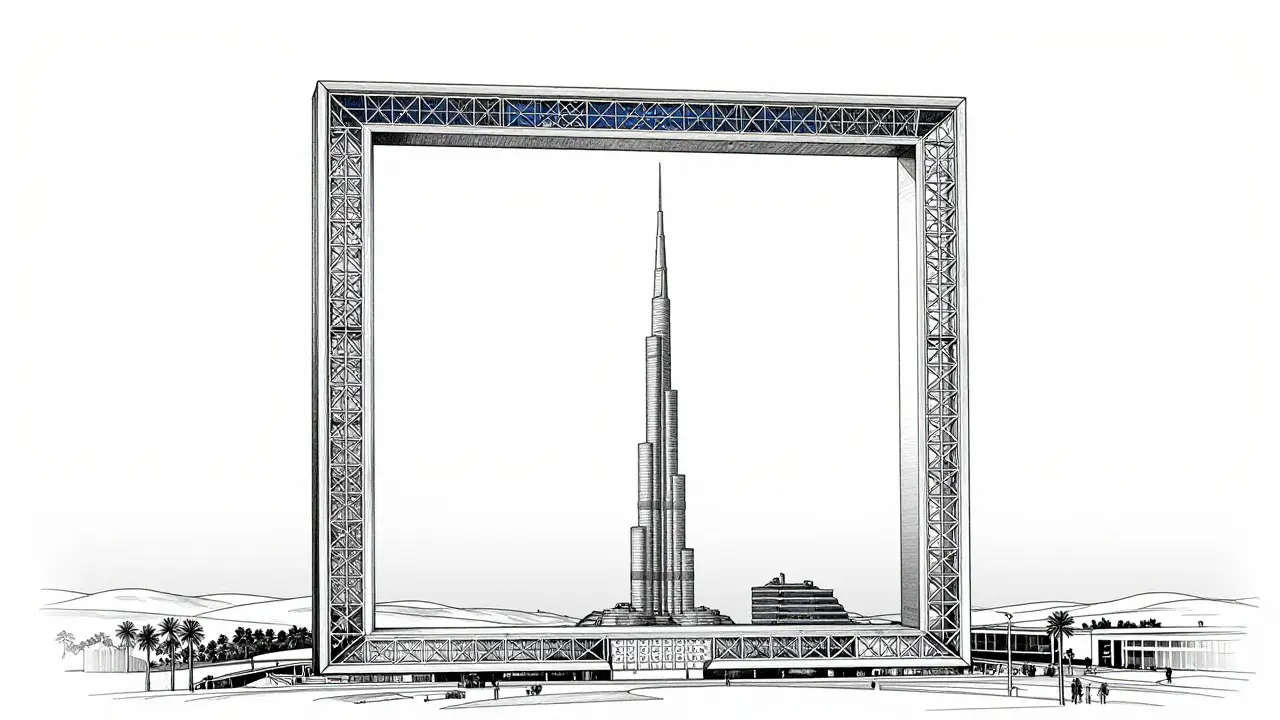
It also plays with perspective. From the ground, the frame looks like a flat rectangle. But as you climb, the angle changes. The Burj Khalifa appears to fit perfectly inside the frame. The old neighborhoods shrink into a patchwork of rooftops. You don’t just see Dubai-you see how it’s layered.
Architects study it for its symbolic clarity. It doesn’t try to be futuristic or ornate. It’s pure geometry. And that’s why it’s become a textbook example in urban design courses-from MIT to the Royal College of Art.
The Experience Inside: More Than Just a View
Walking through the Dubai Frame isn’t just about looking out. It’s about stepping into a story.
The ground floor is a museum called “Dubai: City of Stories.” It uses projection mapping, interactive screens, and soundscapes to take you through Dubai’s transformation-from a fishing village in the 1950s to the global hub it is today. You’ll hear stories from fishermen who remember the old creek, engineers who built the first highways, and artists who painted the city’s first murals.
Then you take the glass elevator up to the sky bridge. The ride itself is part of the experience. The walls are lined with digital timelines. As you rise, the city below shifts from grainy black-and-white footage to crisp 4K drone shots. It’s like watching time accelerate.
At the top, you step onto the glass floor. Below you, the city stretches out in both directions. You can stand directly over the street, looking down at cars the size of toys. On clear days, you can see the Palm Jumeirah in the distance. The wind is stronger up there. You feel exposed. And that’s the point.
How It Compares to Other Dubai Landmarks
Dubai has plenty of tall buildings. The Burj Khalifa is taller. The Museum of the Future looks like a spaceship. The Dubai Frame doesn’t try to outdo them. It does something different.
Unlike the Burj Khalifa, which is a vertical city with hotels, offices, and observation decks, the Dubai Frame is a single-purpose structure. It doesn’t house businesses. It doesn’t sell souvenirs on every floor. It’s designed for one thing: perspective.
Compare it to the Dubai Eye (the giant Ferris wheel). It gives you height. The Frame gives you context. You don’t just see the city-you understand how it evolved.
Even the Burj Al Arab, with its sail-shaped design, is about luxury and spectacle. The Dubai Frame is about reflection. It asks you: How did we get here? Where are we going?
Practical Tips for Your Visit
Here’s what you need to know before you go:
- Best time to visit: Late afternoon. You’ll catch sunset over Old Dubai, then see the city lights come on as the sky darkens.
- Tickets: Around AED 70 (about $19 USD) for adults. Children under 3 get in free. Online booking saves time-lines can get long on weekends.
- How long to spend: 1.5 to 2 hours. Enough to walk through the museum, take the elevator, and soak in the views.
- Getting there: It’s in Zabeel Park, easily reachable by metro (Dubai Frame Station on the Red Line) or taxi. Free parking is available if you drive.
- What to bring: A camera. A light jacket (it’s windy on the bridge). And an open mind.
Is It Worth It? The Real Answer
Some people say it’s overhyped. They’ve seen the Eiffel Tower, the Statue of Liberty, the Sydney Opera House. What’s so special about a frame?
Here’s the truth: the Dubai Frame isn’t about size. It’s about meaning. It’s one of the few landmarks in the world that doesn’t just celebrate achievement-it asks you to question it.
Walk through it, and you’ll see how Dubai didn’t just grow. It reinvented itself. The frame doesn’t hide the old city. It doesn’t erase it. It holds it up next to the new, and lets you decide what matters.
For architecture lovers, that’s rare. Most monuments are about power. This one is about memory.
Dubai Frame vs. Other Iconic Framing Structures
| Structure | Location | Height | Purpose | Architectural Style |
|---|---|---|---|---|
| Dubai Frame | Dubai, UAE | 150 meters | Symbolic bridge between old and new Dubai | Minimalist geometric monument |
| Golden Gate Bridge | San Francisco, USA | 227 meters (towers) | Transportation link | Art Deco suspension bridge |
| Paris Frame (Eiffel Tower) | Paris, France | 330 meters | World’s fair exhibit, now cultural icon | Industrial iron lattice |
| Chapultepec Castle Frame (Mexico City) | Mexico City, Mexico | Not a structure-natural framing by hills | Historic view framing | Topographical composition |
Notice something? The Dubai Frame is the only one designed purely for symbolic framing-not function, not tourism, not transport. It exists to make you look differently.
Frequently Asked Questions
Is the Dubai Frame open every day?
Yes, it’s open daily from 9:00 AM to 9:00 PM. Last entry is at 8:00 PM. It stays open on public holidays, including Eid and National Day.
Can you take photos from inside the frame?
Absolutely. The glass floor and open-air bridge are perfect for photos. The best shots are taken from the center of the bridge, looking straight down at the ground and out toward both sides of Dubai. Avoid midday sun if you want to avoid glare.
Is the Dubai Frame accessible for people with mobility issues?
Yes. The entire experience is wheelchair accessible. Elevators go directly to the sky bridge, and the museum has tactile displays and audio guides. Ramps and wide corridors are standard throughout.
Are there any restaurants or cafes inside?
There’s a small café on the ground floor serving coffee, juices, and light snacks. No full-service restaurants. You’ll find plenty of dining options in Zabeel Park just outside the entrance.
How does the Dubai Frame hold up in desert heat and sandstorms?
The structure was built to handle extreme conditions. The golden cladding is coated with a special anti-corrosion layer that resists salt, sand, and UV damage. The glass is reinforced and self-cleaning. It’s been tested in simulated sandstorms and temperatures over 50°C (122°F).
Final Thought: Why This Matters
Dubai could have built another skyscraper. It could have spent billions on a theme park or a luxury hotel. Instead, it chose to build a frame. A simple, empty rectangle. And that’s what makes it unforgettable.
It doesn’t shout. It doesn’t sell. It just asks: What do you see when you look at your city? And what do you want it to become?
If you’re an architecture enthusiast, that’s the kind of question worth walking 150 meters to answer.